9 min readVASA
Best Mobile Traffic Sources for E-Commerce in 2026 (High ROAS & DTC Strategy)
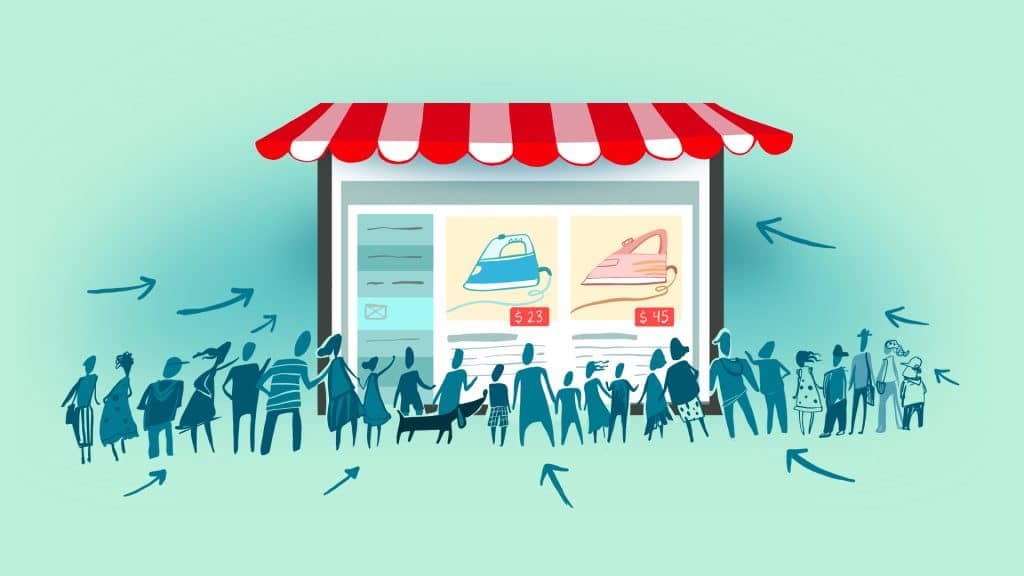
You built the store. The products look good. The checkout is smooth. But nobody’s showing up - or worse, the people who do show up click around and leave without buying.
Here is the uncomfortable truth for many DTC brands right now: over 80% of e-commerce traffic now happens on mobile. Despite this, the majority of store owners still design their funnels, ad creatives, and retention flows for desktop users. That gap in user experience is exactly where your revenue is leaking. In 2026, the buying moment isn't just "mobile-first"; it is entirely mobile-native.
If your traffic strategy relies solely on traditional Google Search and basic Facebook image ads pointing to a clunky Shopify product page, your Customer Acquisition Cost (CAC) will bleed your margins dry. Today’s consumers expect single-tap checkouts, AI-curated product discovery, and frictionless social commerce.
TL;DR: Mobile devices drive 60% of global e-commerce sales ($4.01 trillion) in 2026. TikTok Shop (4.7% conversion) and Meta Advantage+ (4.5x ROAS) are the top-performing acquisition channels. For high-intent traffic, AI-referred traffic (Perplexity) converts at a massive 14.2%, while Amazon DSP converts at 10.5%. For retention, SMS marketing continues to deliver outsized returns with 98% open rates and up to 45x ROI. To win, DTC brands must diversify their "Traffic Stack" across Discovery, Intent, Retention, and AI Search.
Before we dive into the specific channels, we need to understand the structural shift in how users buy. Mobile commerce (m-commerce) is projected to reach $4.01 trillion globally in 2026, accounting for roughly 60% of all online retail sales (Imvasa Market Research, 2026). The stores scaling right now treat mobile not as a secondary screen, but as the foundational architecture of their entire revenue engine.
A donut chart illustrating that mobile devices will account for 80% of global e-commerce traffic by 2026, while desktop accounts for 20%. 80% Mobile Traffic Mobile (80%) Desktop (20%) Source: Imvasa Ecommerce Index (2026)
Traffic is useless if your site speed kills the conversion. According to our experience with DTC scaling, winners build for "single-tap" checkouts using Apple Pay, Google Pay, or Shop Pay. If your mobile page load time exceeds 2.5 seconds, you lose roughly 20% of your conversions before the user even makes their first scroll.
Furthermore, data shows that native mobile apps significantly outperform mobile websites for retention, offering 157% higher conversion rates and superior user experiences. While you don't need an app to start, scaling brands eventually move their best buyers into an owned app ecosystem.
Social media is no longer just for building brand awareness; it has evolved into a native transaction engine. In 2026, forcing a user to leave a social app to buy on your website is the fastest way to kill a sale. If you want the full playbook behind building a profitable content-to-conversion engine, read our guide on the social media marketing system that actually works in 2026
TikTok Shop has fundamentally altered e-commerce by removing the friction between discovery and purchase. Currently, TikTok Shop conversions have surged to an average of 4.7%, which is more than double Instagram's 2.1%.
The strategy for TikTok Shop isn't just about running ads; it’s about Spark Ads and affiliate armies. By offering a 10-15% commission to micro-creators, you create a decentralized sales force. The "see it, tap it, buy it" native checkout means the user never waits for a browser to load.
For those who thought Facebook and Instagram ads were dead post-iOS 14, Meta’s AI returned with a vengeance. Meta Advantage+ Shopping Campaigns (ASC) deliver an average ROAS of 4.52x, significantly outperforming the broader e-commerce average of 2.79x.
ASC takes the guesswork out of media buying. Instead of creating hundreds of ad sets manually, you feed the algorithm your budget, your catalog, and your best creatives, and the AI automatically tests and optimizes delivery across Reels, Stories, and the feed.
Pro Tip: In 2026, your targeting is your creative. Highly polished studio shots fail on Reels. You need UGC-style, lo-fi video content that natively blends into the user's feed to win with ASC.
A bar chart showing TikTok Shop significantly outperforming Instagram and Facebook Shopping in conversion rates for 2026. 4.7% 2.1% 1.8% TikTok Shop Instagram Facebook Source: Imvasa Social Commerce Report (2026)
Working with influencers is no longer about paying a flat fee for a single post that dies in the feed 24 hours later. In 2026, the strategy is built on Influencer Whitelisting (also known as allowlisting) and Dark Posting.
Influencer whitelisting is when a brand gets permission to run paid traffic through the influencer's actual social media handle. Instead of the ad coming from "Your Brand," it comes from "@FitnessGuru."
Why does this matter? Because consumers have extreme ad blindness. Ads that look like native creator content bypass this blindness. Studies show that whitelisting can outperform traditional brand ads by 20-50% and boost ROAS by 1.5 to 2 times.
Dark posts are ads run under the influencer's handle that do not appear on their public organic feed. This is incredibly powerful for E-commerce because you can perform rigorous A/B testing on different calls-to-action (CTAs), hooks, and landing pages without spamming the creator's audience.
By combining the authentic voice of the creator with the hyper-targeting capabilities of Meta or TikTok's ad engines, whitelisting has reduced customer acquisition costs (CAC) by as much as 30% for top DTC brands.
If social media is for discovery, Retail Media Networks (RMNs) are for capturing pure, high-intent buying behavior. By 2026, RMNs are projected to be a $130.2 billion industry, accounting for nearly 29% of all U.S. digital advertising.
Amazon DSP is the apex predator of e-commerce retargeting. It allows brands to programmatically buy display and video ads both on Amazon and off Amazon across the web, utilizing Amazon's incredible first-party purchase data.
The conversion rates here are staggering. The expected average conversion rate for Amazon advertising in 2026 is 10.2% to 10.5%. Furthermore, mobile devices show a 15% higher Click-Through Rate (CTR) than desktop, accounting for 65% of all clicks on Amazon.
Don’t ignore the legacy retail giants. Walmart Connect reaches over 240 million customers weekly, combining online intent with physical store data. Walmart Connect currently delivers 2.8x stronger incremental ROAS and 2x higher sales lift compared to standard digital media benchmarks.
The Strategy: Use Meta/TikTok to build cheap awareness, and use Amazon DSP/Walmart Connect to capture the intent when the user is actually ready to pull out their credit card.
The era of typing queries into a search box and scrolling through ten blue links is dying. Welcome to the era of Generative Engine Optimization (GEO).
AI-referred traffic from platforms like Perplexity and ChatGPT search converts at a massive 14.2%, which is nearly 5x higher than traditional Google organic traffic. While the volume of traditional search is declining, AI search sends "decision-ready" users who have already been "pre-sold" by the AI’s synthesized, trusted answer.
According to our latest analysis, 58% of enterprise and high-intent buyers now consult AI assistants before making a purchase.
A horizontal bar chart showing AI-referred traffic converts significantly higher (14.2%) compared to traditional mobile web and search sources. AI-Referred 14.2% Mobile App 3.6% Google Search 2.9% Mobile Web 2.1% Source: Yotpo and Stormy.ai (2026)
By 2026, Google AI Overviews appear on 14% of all shopping queries. To win here, your brand needs "Citation Authority." Large Language Models (LLMs) value density and trusted sources. You must format your blog posts and product pages using the "Atomic Answer" framework (like the H2 structures in this very post) to make data easily extractable. Additionally, PR mentions in trusted third-party forums like Reddit, Quora, and major publications act as the "ground truth" that AI systems use to verify your products are legitimate.
You paid a fortune to acquire the customer. If you don't retain them, you lose money. With rising CACs across paid social, retention is where the actual profit margin lives.
In 2026, SMS is not optional. SMS messages boast an incredible 98% average open rate, with 90% read within three minutes of delivery. Compare that to email's generous 20% open rate, and the winner is clear.
The response rate for SMS stands at 45% (vastly outperforming email’s 6%), and E-commerce SMS campaigns generate a conversion rate of 29%. Cart abandonment SMS reminders alone can recover an average of 20% of lost sales. When executed correctly with personalization and segmentation, SMS marketing yields an ROI between 35x and 45x.
Warning: Do not abuse SMS. Sending more than 2-3 promotional texts a week will lead to massive opt-out rates. Stick to high-value offers, early access drops, and strictly transactional updates (shipping, out-for-delivery).
Browser and App push notifications act as a high-velocity, low-cost retention tool. Push notifications boast a 90% average delivery open rate when users grant permission.
Automated push notifications - specifically transactional updates, price drops, and back-in-stock alerts - make up only 5% of total sends but are responsible for 28% of all push-attributed orders. Keeping notifications to seven words or fewer can boost engagement by an astounding 94%.
If you have exhausted Meta and TikTok, and you need cheap, high-volume clicks to fill the top of your funnel, Native Ads and Push Networks are the answer.
Not to be confused with owned push notifications, these are paid ads that appear directly on Android devices as system notifications. They bypass ad blockers and appear right on the user's lock screen. With CPCs starting as low as $0.003 in some GEOs, they offer massive, affordable reach. They require aggressive, curiosity-inducing copy and work best for highly impulsive, mass-market products.
Relying on a single source of mobile traffic in 2026 is a recipe for failure. The most successful E-commerce operators build a diversified, resilient "Traffic Stack":
The Discovery Engine: TikTok Shop (Creators/Affiliates) or Meta Advantage+ (ASC) to find new, cold audiences using high-velocity vertical video.
The Intent Harvester: Amazon DSP or Google Performance Max to capture high-intent users actively searching for solutions.
The Authority Pillar: GEO optimization and PR strategies to ensure Perplexity, ChatGPT, and Google AI Overviews cite your brand as the definitive answer.
The Retention Loop: SMS marketing workflows and strategic App/Browser Push notifications to drive repeat purchases for pennies.
The Trust Multiplier: Influencer whitelisting to inject authenticity into your paid media buying.
More insights from the blog that you might find interesting.

A web performance and SEO strategist specializing in service-based businesses, helping new websites grow from zero to 500–700 monthly visitors and 100K–200K impressions within six months. With hands-on experience improving Core Web Vitals for clients across multiple industries, the results speak for themselves including ranking jumps from #18 to #2 and measurable increases in leads and conversions. Tools of choice: PageSpeed Insights, Google Search Console, and Chrome DevTools. The focus is always the same: real traffic, real leads, real growth

Anthropic has launched Claude Design, a research preview product that lets subscribers describe what they need visually prototypes, slides, one-pagers, pitch decks and have Claude build it.
Master Google Business Profile for plumbers, electricians, HVAC contractors, and locksmiths in 2026. Learn how to dominate zero-click searches, leverage LSA ads, and get more calls